
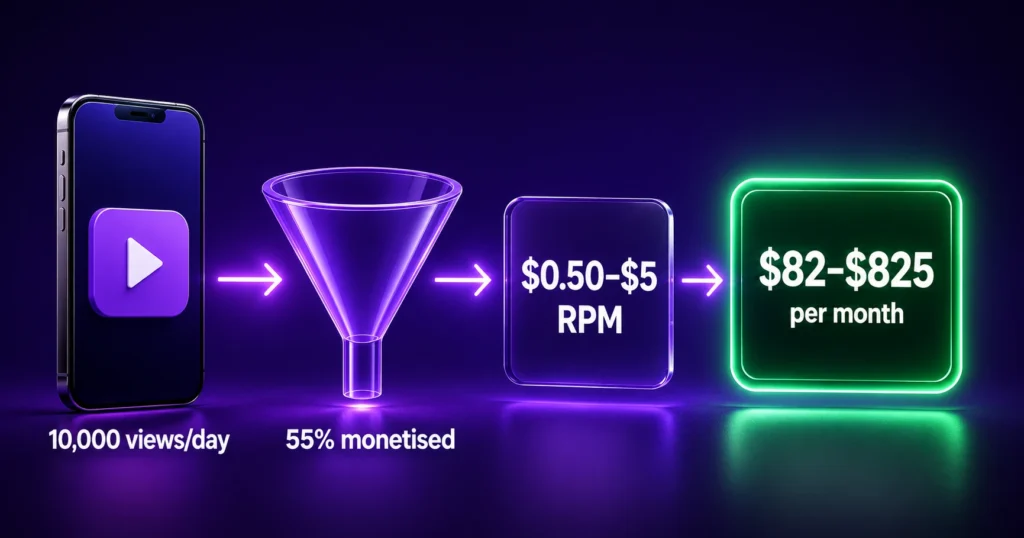
“How much do YouTubers make per 1,000 views?” has no single answer, and anyone who gives you one is guessing. The honest version is a range — and once you understand the three numbers that set that range, you can estimate your own channel far more accurately than any headline figure.
Quick answer: creators typically keep somewhere between $0.50 and $5 per 1,000 monetised views, and only about 40–60% of views are monetised at all. So 10,000 views a day works out to roughly $2.75–$27.50 a day. Model your own channel with the free YouTube Money Calculator.
1RPM vs CPM — the distinction that matters
These two get used interchangeably and they mean opposite things:
| Term | Whose money | What it tells you |
|---|---|---|
| CPM (cost per mille) | What the advertiser pays per 1,000 ad impressions | Market demand for your audience — always the bigger, more flattering number |
| RPM (revenue per mille) | What you keep per 1,000 views | Your actual take-home, after YouTube’s cut and across all your views |
For long-form watch page ads, the split is 55/45 — creators keep 55% of the ad revenue and YouTube keeps 45%. So a $10 CPM does not put $10 in your pocket, and RPM is spread across every view including the ones that never showed an ad. That is why RPM is usually a small fraction of CPM. Screenshots of huge CPMs in “I made $X” videos are, more often than not, quietly showing the advertiser’s number.
2The maths, with a real example
Take a channel doing 10,000 views a day, with 55% of those views monetised:
| Step | Working | Result |
|---|---|---|
| Monetised views | 10,000 × 55% | 5,500 |
| At a low RPM of $0.50 | 5.5 × $0.50 | $2.75 per day |
| At a high RPM of $5.00 | 5.5 × $5.00 | $27.50 per day |
| Per month | × 30 | $82.50 – $825 |
| Per year | × 365 | ≈ $1,004 – $10,038 |
Same channel, same views, and a tenfold gap in annual income. That gap is what everyone arguing about YouTube earnings is actually arguing about.
3What decides where you land in that range
- Your niche. Advertisers pay far more to reach people making expensive decisions. Finance, business, software, insurance and legal content command the highest rates; general entertainment, gaming and music sit near the bottom.
- Your audience’s country. Views from high-ad-spend markets are worth several times views from lower-spend ones. Two identical channels with different audience geographies earn very differently.
- Video length and ad placement. Longer videos can carry mid-roll ads, which lifts RPM substantially compared with a short video showing one pre-roll.
- Format. Shorts monetise through a different revenue pool than long-form watch page ads, and typically produce a much lower RPM per view.
- Season. Ad spend peaks in the run-up to the end of the year and falls sharply in January. The same video can earn noticeably more in December than in the new year.
- Advertiser-friendliness. Videos limited for advertising serve fewer ads and earn less, which drags the monetised-view percentage down.
Use your own RPM, not an average from an article. If your channel is already monetised, YouTube Studio → Analytics → Revenue shows your real RPM for any date range. Type that into the calculator and the estimate stops being a guess. If you are not monetised yet, start with the $0.50–$5.00 range and narrow it once you have data.
4You have to qualify first
Ad revenue only starts once you are in the YouTube Partner Program. There are two routes to the main monetisation tier, and you need 1,000 subscribers plus either:
| Route | Requirement |
|---|---|
| Long-form | 4,000 valid public watch hours in the last 12 months |
| Shorts | 10 million valid public Shorts views in the last 90 days |
You also need to live in an eligible country, follow the channel monetisation policies, have no active Community Guidelines strikes, and link an AdSense account. Thresholds and features change, so confirm the current rules on YouTube’s own Partner Program page before planning around them.
5Ads are rarely the biggest line
Most established creators earn more outside AdSense than inside it. Worth knowing before you judge a channel by its ad revenue alone:
- Sponsorships and brand deals. Usually the largest income source, and priced on audience quality rather than raw views — which is why engagement rate matters so much to negotiations.
- Affiliate links. Steady, compounding income from videos that keep getting found, particularly reviews and tutorials.
- Memberships, Supers and merch. Direct audience support, which scales with community strength rather than reach.
- Your own products. Courses, templates, software and services — the highest margin of the lot.
6Estimate your channel
The YouTube Money Calculator takes daily views, the share that are monetised and a low-to-high RPM range, and returns daily, monthly and yearly estimates. It is deliberately a range, not a single confident number, because a single number would be dishonest.
Alongside it: the YouTube Tag Generator for video metadata, the Thumbnail Downloader for competitive research, and the Social Media Image Resizer for a correctly sized 1280 × 720 thumbnail.
Estimates, not promises. Every figure here is a planning aid based on typical ranges. Actual payouts depend on your niche, audience location, watch time, ad inventory and YouTube’s current terms — none of which any calculator can see. Do not make financial commitments on a projection.
7Frequently Asked Questions
How much do YouTubers make per 1,000 views?
Typically between $0.50 and $5 per 1,000 monetised views, depending on niche and audience country. Since only around 40–60% of views are monetised, the effective figure per 1,000 total views is lower again.
How much does YouTube pay for 1 million views?
Using the same range, roughly $275 to $2,750 — because about 550,000 of those million views would be monetised at a 55% rate. Finance and business channels can exceed the top of that; entertainment and gaming often fall below it.
What is the difference between RPM and CPM?
CPM is what advertisers pay per 1,000 ad impressions; RPM is what you actually keep per 1,000 views after YouTube’s 45% share. RPM is the number that matters to your bank account.
How many subscribers do you need to make money on YouTube?
1,000 subscribers, plus either 4,000 valid public watch hours in the past 12 months or 10 million valid public Shorts views in the past 90 days.
Do YouTube Shorts pay as much as long videos?
Generally no. Shorts are monetised from a separate revenue pool and typically generate a much lower RPM per view than long-form watch page ads, though they can grow an audience far faster.
Why did my RPM suddenly drop?
The most common reasons are seasonal — ad spend falls sharply in January after the year-end peak — along with a shift in audience country, more Shorts in the mix, or videos being limited for advertising.
Know your RPM, and the guesswork stops.