
Follower count is the number people brag about. Engagement rate is the number brands actually check — because 100,000 followers who scroll past you are worth less than 5,000 who comment, save and share. Here is how to calculate it properly, what counts as good, and why two people can measure the same account and get very different answers.
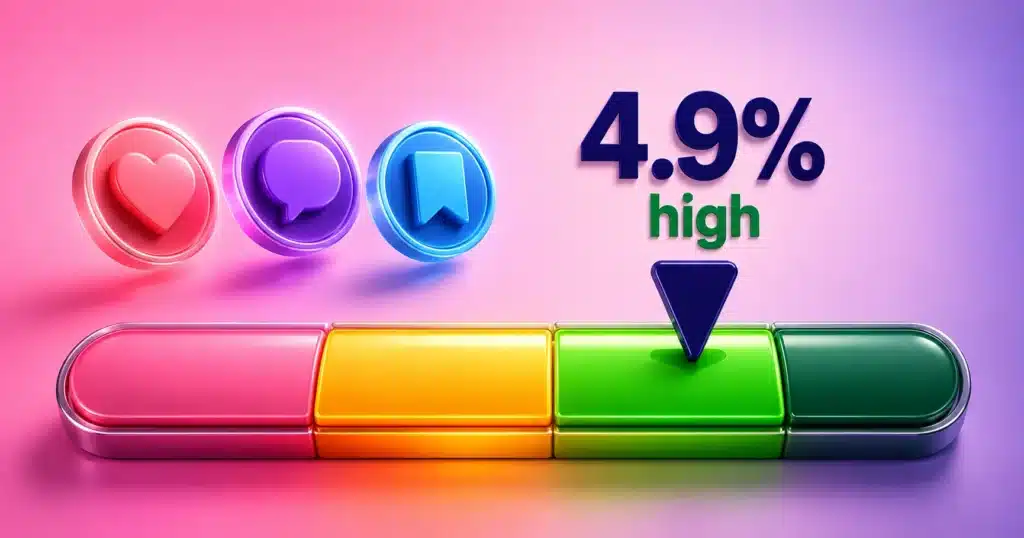
Quick answer: engagement rate = (likes + comments) ÷ followers × 100. Anything under 1% is low, 1–3.5% is average, 3.5–6% is high and 6%+ is excellent. Work out yours in a few seconds with the free Engagement Rate Calculator.
1The formula
Saves and shares are optional but worth including if you have them, because on most platforms they are the strongest signals of all — a save means someone wants to come back to your post, and a share means they were willing to put their own name next to it.
A worked example. An account with 10,000 followers averaging 450 likes and 35 comments per post:
| Step | Working | Result |
|---|---|---|
| Total interactions | 450 + 35 | 485 |
| Divide by followers | 485 ÷ 10,000 | 0.0485 |
| Convert to a percentage | × 100 | 4.85% |
| Adding 60 saves and shares | 545 ÷ 10,000 × 100 | 5.45% |
4.85% sits comfortably in the “high” band — a healthy, active audience.
2What counts as good
| Engagement rate | Band | What it usually means |
|---|---|---|
| Under 1% | Low | Content isn’t landing, or the follower base is inflated or inactive |
| 1% – 3.5% | Average | Normal, healthy performance for most accounts |
| 3.5% – 6% | High | An engaged, well-matched audience — attractive to brands |
| Over 6% | Excellent | Strong community, usually a focused niche or a smaller account |
Benchmarks are context, not a grade. Engagement varies enormously by platform, niche and account size, and published industry averages disagree with each other because they measure different things. Use the bands to spot a problem, then compare yourself against your own history and against accounts of a similar size in your own niche — not against a number from a report about a different industry.
3Why smaller accounts score higher
It is consistently observed that engagement rate falls as follower count rises, and the reasons are structural rather than a failure on anyone’s part:
- Early followers are your closest audience. The first thousand people usually found you deliberately. The hundred-thousandth arrived from a viral clip and may not care about the rest.
- Feeds only show your post to a fraction of followers. The bigger the account, the smaller that fraction tends to be as a proportion.
- Inactive and abandoned accounts accumulate. They stay in your follower count forever and never engage again.
This is exactly why brands increasingly pay micro-creators: 8,000 followers at 7% delivers more real interaction than 200,000 at 0.4%, usually for a fraction of the fee.
4Followers, reach or impressions?
The same post can produce three different engagement rates depending on the denominator, which is why quoted numbers so often disagree:
| Divide by | Called | Best for |
|---|---|---|
| Followers | Engagement rate by followers (ER) | The standard for comparing accounts and for brand deals — anyone can verify it |
| Reach | Engagement rate by reach (ERR) | Judging content quality: of the people who actually saw it, how many acted? |
| Impressions | Engagement rate by impressions | Paid campaigns, where the same person may see a post repeatedly |
Reach-based rates are almost always the highest, because reach is smaller than follower count for most posts. Neither is dishonest — but say which one you are quoting. A creator advertising “12% engagement” measured against reach is not comparable to one quoting 4% against followers.
5How to actually improve it
- Ask for the interaction you want. A specific question in the caption outperforms “thoughts?” every time. People respond to prompts they can answer in four words.
- Make saveable things. Checklists, how-tos, comparisons and reference charts get saved, and saves are weighted heavily.
- Reply to every comment early. The first hour matters most, and replies are engagement too.
- Post less, better. Halving your output and doubling the effort usually raises the average — engagement rate is a per-post average, so filler drags it down.
- Prune bought or bot followers. They inflate the denominator and nothing else. If your rate collapsed without your content changing, this is often why.
- Match the format to the platform. Vertical video for Reels and Shorts, carousels for teaching, stills for aesthetics. Our social media image size guide covers the exact dimensions.
6Measure it properly
The Engagement Rate Calculator takes followers, average likes, average comments and optionally saves and shares, and returns your rate with the band it falls into. Use the average across your last 9–12 posts rather than one — a single viral post is not your engagement rate, and a single flop is not either.
The rest of the toolkit: the Hashtag Generator for tag sets, the Character Counter for caption limits, the Instagram Bio Generator for the profile itself, and the YouTube Money Calculator if your audience is on video. All free, all in your browser.
7Frequently Asked Questions
What is a good engagement rate on Instagram?
1% to 3.5% is average, 3.5% to 6% is high, and above 6% is excellent. Smaller and more focused accounts routinely score at the top of that scale, while very large accounts often sit below 1%.
How do I calculate my engagement rate?
Add likes and comments (plus saves and shares if you track them), divide by your follower count and multiply by 100. Use the average across your last nine to twelve posts rather than a single one.
Is a 5% engagement rate good?
Yes — 5% sits in the high band and indicates an audience that genuinely interacts with your content. For an account above roughly 100,000 followers it would be exceptional.
Why is my engagement rate dropping as I gain followers?
Because the denominator grows faster than interaction does. New followers are typically less connected to you than early ones, and inactive accounts accumulate over time. A falling rate alongside steady or rising total interactions is usually fine.
What is the difference between engagement rate by followers and by reach?
By followers divides interactions by your total audience; by reach divides by the number of accounts that actually saw the post. Reach-based figures are almost always higher, so always state which you are quoting.
Do saves and shares count as engagement?
Yes, and they carry more weight than likes on most platforms because they signal genuine value. Include them in the calculation if your analytics report them — the calculator has a field for exactly that.
Followers are the audience. Engagement is whether they’re listening.