User Guide
Add your .docx file
Drag a Word file onto the drop zone, or click it to browse. Your browser opens the file and reads it into memory — nothing is sent anywhere, so there is no upload bar and no queue. Only modern .docx files are accepted; drop a legacy .doc and the tool tells you so and points you at the DOC to PDF Converter.
Check the file panel
A green panel confirms the file name and its size, so you know the right draft is loaded before you spend time converting. The × button clears it; Clear resets everything, including the options and the preview.
Set the page size and orientation
Letter (8.5 × 11 in) is the default, with A4 (210 × 297 mm) and Legal (8.5 × 14 in) alongside it, each in portrait or landscape. A 14 mm margin is applied on all four sides and is not adjustable, so an A4 page carries 182 × 269 mm of content.
Choose the render quality
The control is labelled Image Quality, but it sets the resolution of the whole page, text included. High renders at roughly 192 PPI, Medium at 144 and Standard at 96. Keep High unless the document is long. Switching Embed images off replaces every picture with an invisible placeholder — useful for a lightweight text-only proof.
Convert, and watch the five stages
Press Convert to PDF and the progress strip lights up in order: Read file, Parse DOCX, Render, Build PDF, Done. If something goes wrong you can see which stage it failed at, which usually tells you whether the file or the rendering was the problem.
Read the preview, then download
A Document Preview panel shows exactly what has been extracted from the .docx — read it before you download, because anything missing there will be missing from the PDF. The result chips report the page count, the finished file size and how long it took. Download PDF saves it under your original file name with a .pdf extension.
About the Word to PDF Converter
This tool turns a Microsoft Word .docx document into a PDF without the file ever leaving your computer. Reading, parsing, rendering and PDF assembly all happen inside this browser tab, using JavaScript that runs on your own machine. There is no upload, no processing queue, no temporary copy sitting on a server waiting to be deleted, and no account to create.
That single design decision is what the tool is for. Most free Word-to-PDF services work by receiving your document, converting it on their infrastructure and handing back a link — which is perfectly fine for a shopping list and quietly unacceptable for a signed contract, a salary letter, a medical form or a document covered by a client NDA. Here, the question of what a third party does with your file never arises, because no third party ever receives it.
What actually happens when you press Convert
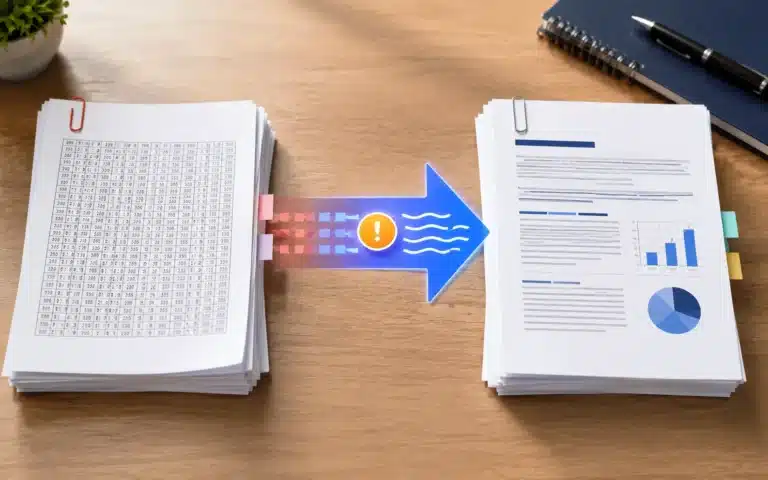
A .docx file is a ZIP archive of XML. The tool unzips it in memory and walks that XML to rebuild the document’s structure — headings, paragraphs, lists, tables, images, links, footnotes. That structure is laid out on a virtual page exactly as wide as your chosen paper minus the 14 mm margins, and then photographed: the whole document is drawn to one tall bitmap, sliced at page height, and each slice is placed on a PDF page as a JPEG at quality 0.92.
Understanding that pipeline explains almost everything about the result — what survives the trip, what does not, why the file is bigger than you expected, and why the text cannot be selected. The rest of this page is that explanation, stated plainly, because guessing wrong about a PDF is expensive when it is going to a university portal or a recruiter.
What carries over from Word — and what does not
Carried over faithfully: headings built with Word’s own Heading 1–6 styles, bold and italic, strikethrough, superscript and subscript, bulleted and numbered lists nested up to five levels, tables including merged cells, embedded images, working hyperlinks, and footnotes and endnotes — which are gathered into a list at the end of the document with a link back to where each one was referenced. Text sitting inside a Word text box is extracted too, though it arrives as an ordinary paragraph rather than a floating box.
Dropped, and you should know it before you convert: font family, font size and text colour; highlighting; underline; small caps and all caps applied as a format rather than typed; paragraph alignment and indents, so a centred title arrives left-aligned; tab stops, which collapse to a single space and take CV-style “role on the left, dates on the right” layouts with them; headers, footers and page numbers, which are never read at all; explicit page breaks; review comments; equations; and charts, SmartArt and WordArt.
Tracked changes deserve their own line. Deletions are discarded and insertions are kept, so the PDF reads as though every change had been accepted. If a document is mid-review, accept or reject the changes in Word first — otherwise you may publish an edit somebody had not yet agreed to.
The practical rule: this converter preserves the document, not the typography. A report built properly out of Word styles comes through recognisably. A one-page flyer whose whole identity is a font, a colour and a centred block of text does not.
The PDF has no text layer — what that means for you
Because each page is a picture of the page, the finished PDF contains no selectable text. You cannot copy a paragraph out of it, Ctrl+F will not find anything inside it, a screen reader cannot read it, and an applicant tracking system cannot parse it. The file is also several times larger than one Word itself would have produced, because a photograph of a page of text costs far more bytes than the text does.
For a great many jobs none of that matters. If the PDF is going to be printed, signed, stamped, emailed as a fixed-layout copy, or uploaded to a portal that just stores and displays it, an image PDF behaves exactly like any other. Where it matters — and matters a lot — is a CV or résumé sent through a job portal. Most applicant tracking systems read the text layer to build your candidate profile; handed a page of pixels, many will extract nothing and score you against an empty document. For that one job, use Word’s own File → Save as → PDF, or Google Docs’ Download → PDF, both of which write a real text layer. It costs you nothing to be told this here rather than to find out from silence.
The same applies if you need the PDF to be searchable later — an archive of minutes, a research paper, anything you will grep through in two years. Convert those the same way, or convert here and accept that the file is a picture.
Choosing page size and quality — the arithmetic
Letter measures 215.9 × 279.4 mm and A4 measures 210 × 297 mm, so A4 is narrower and noticeably taller. Subtract the fixed 14 mm margins and a Letter page holds 187.9 × 251.4 mm of content against A4’s 182 × 269 mm — about 18 mm more vertical room per page on A4, which is usually a page saved over a long document. Pick by where the file is going: A4 across Europe, India, Australia and most of Asia and Africa; Letter in the United States and Canada.
The quality setting is the one worth thinking about. A Letter content column is 187.9 mm, or 7.4 inches, and is drawn 710 pixels wide before scaling. High doubles that to 1,420 pixels across 7.4 inches — about 192 PPI. Medium gives 144 PPI and Standard 96 PPI. Commercial print wants 300 PPI for photographs, so a full-page photo will look visibly softer than it would from Word; body text and screenshots at 192 PPI print cleanly and read perfectly on screen.
Quality also decides how long a document you can convert. Every page is drawn onto a single canvas, and browsers cap how tall a canvas may be — roughly 32,000 pixels in desktop Chrome and about half that on an iPhone. At High quality a Letter page is about 1,900 pixels tall, so the ceiling arrives somewhere around 17 pages on a desktop and 8 on a phone. If a long document fails to render or comes back blank, drop to Medium or Standard — Standard roughly doubles the ceiling — or split the document in Word and convert it in halves.
When this tool is the right choice
It earns its place whenever the document is confidential, the machine is locked down, or there is simply no Word licence to hand. A tenancy notice with an address and a signature on it; a university assignment where the submission portal accepts PDF only; meeting minutes going out to a committee; a proposal being sent from a client’s laptop where installing software is not an option; a coursework draft converted on a phone between lectures. In each case the conversion takes seconds, costs nothing, leaves no trace on anyone’s server, and produces a file that opens identically for every recipient.
It is the wrong choice for exactly three things: an ATS-parsed résumé, a document you will need to search or copy from later, and a design-led page whose fonts and colours are the point. Those three have better routes, named above.
What to do with the PDF next
Once you have the file, the rest of the toolkit picks it up. Compress PDF brings the size down if a portal has a limit — worth knowing, because image PDFs respond very well to compression. Merge PDF joins your converted document to a scanned ID or a covering letter, and Split PDF pulls out the pages you actually need to send. Add Page Numbers and Add Header and Footer put back the running elements Word’s own headers and footers left behind. Add Signature signs it, Add Watermark marks it as a draft or a copy, and Protect PDF puts a password on it before it leaves your outbox.
Going the other way — a PDF you need to edit as a Word file — use the PDF to Word Converter, and read Convert PDF to Word Without Losing Formatting first; it explains why that direction goes wrong so often and how to keep the layout intact.
Limits worth knowing before you start
Only .docx is supported: a Word 97–2003 .doc is a completely different, binary format, and renaming one to .docx will not work — send those to the DOC to PDF Converter, which converts on the server instead. A password-protected .docx cannot be opened, because the archive is encrypted before the tool ever sees the XML; remove the password in Word first. There is no batch mode, so documents are converted one at a time. The margin is fixed at 14 mm. And because everything runs on your own hardware, the practical size ceiling is your device’s memory rather than a server limit — which is generous on a laptop and rather less so on an older phone.
One honest caveat about the privacy claim, so it is not oversold: your document never leaves the browser, and that is absolute. The page itself still loads its conversion libraries over the network like any web page, so you do need to be online to open the tool — you simply do not need to be online for your file to be read by anyone but you.
Frequently Asked Questions
How do I convert a Word document to PDF for free?
Drag your .docx file into the tool, choose a page size and orientation, and press Convert to PDF. The conversion runs in your browser and the download appears within seconds. There is no sign-up, no watermark, no page limit and no cost, and you do not need Microsoft Word installed.
Is my document uploaded to a server?
No. The file is opened by your browser and every stage — unzipping the .docx, reading its XML, rendering the pages and assembling the PDF — runs on your own machine. Nothing is transmitted, stored or logged, which makes the tool safe for contracts, payslips, medical forms and other private documents.
Will the PDF look exactly like my Word document?
The structure will match; the typography will not. Headings, lists, tables, images, links and footnotes come through faithfully, but font family, size, colour, highlighting, underline, alignment and indents are dropped, so a centred title arrives left-aligned in the tool’s own clean typeface. Documents built from Word styles convert best.
Why can’t I select or search the text in the PDF?
Because each page is rendered as an image and placed into the PDF as a picture, so the file has no text layer. That is fine for printing, signing or sharing a fixed-layout copy. If you need selectable, searchable text, use Word’s own File → Save as → PDF, or Google Docs’ Download → PDF, both of which write real text.
Can I use this for a resume I’m sending to a job portal?
Only if a human will open it. Most applicant tracking systems read the PDF’s text layer to build your profile, and this tool’s output has none, so an ATS may extract nothing at all from it. For any application that goes through a job portal, export the PDF from Word or Google Docs instead. Use this tool for CVs you are printing or emailing directly.
Where did my headers, footers and page numbers go?
They are never read. The converter extracts the body of the document only, and Word’s header and footer areas — including automatic page numbers — sit outside it. You can put them back onto the finished PDF with Add Page Numbers to PDF or Add Header and Footer to PDF.
What about older .doc files from Word 97–2003?
A .doc file uses a completely different binary format that cannot be read in the browser, and renaming it to .docx will not help. Open it in Word and save a copy as .docx, or send the original to our DOC to PDF Converter, which handles the legacy format with a server-side conversion.
My document is long and the conversion failed or came out blank. What now?
Long documents are drawn onto a single canvas and browsers cap how tall that canvas can be — roughly 17 pages at High quality on a desktop, about 8 on a phone. Switch Image Quality to Medium or Standard, which roughly doubles the ceiling, or split the document in Word and convert it in two halves.
Should I choose A4 or Letter?
Choose by destination rather than by habit. A4 (210 × 297 mm) is standard in Europe, India, Australia and most of Asia and Africa; Letter (8.5 × 11 in) is standard in the United States and Canada. A4 is narrower but taller, so it fits about 18 mm more text per page, which can save a page over a long report.
Do I need Microsoft Word or an internet connection?
You do not need Word, Office or any installed software — a modern browser on a laptop, tablet or phone is enough. You do need to be online to load the page itself, as with any website, but your document is still never sent anywhere; it is read and converted entirely on your own device.