
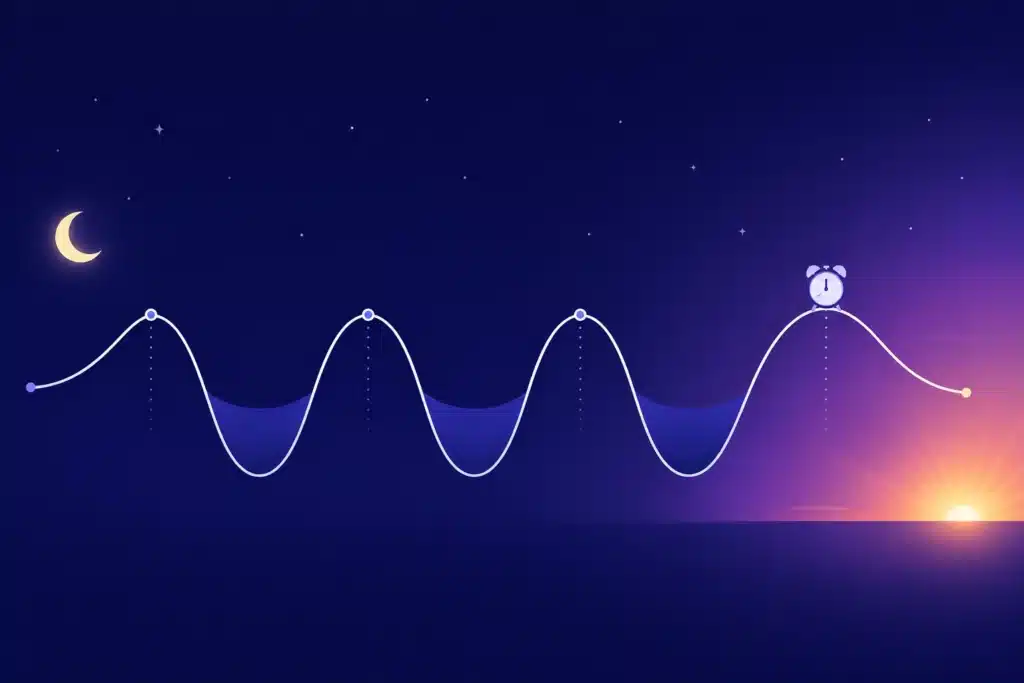
Most people set an alarm and work backwards in whole hours: up at 6:30, so bed at 11, so that’s seven and a half hours, near enough. It usually is near enough — but the reason some mornings feel civilised and others feel like being dragged out of a well has less to do with total hours than with where in a sleep cycle the alarm lands. Here is how to pick a bedtime that works with your sleep rather than against it.
Quick answer: sleep runs in cycles of roughly 90 minutes, so good targets are whole multiples — 6 hours (4 cycles), 7.5 hours (5) or 9 hours (6) — plus the 10–20 minutes it takes you to fall asleep. To wake at 6:30 AM, aim to be asleep by 11:00 PM (5 cycles) or 9:30 PM (6 cycles). The Sleep Calculator works it out in either direction.
1What a sleep cycle is
Sleep is not one flat state. Across a night you move repeatedly through light sleep, deep slow-wave sleep and REM sleep, and one full pass takes about 90 minutes on average. The mix shifts as the night goes on: deep sleep dominates the early cycles, REM stretches out in the later ones. That is why the last two hours before your alarm are not “extra” — they carry most of your dreaming sleep.
Waking naturally at the end of a cycle, in light sleep, feels easy. Being pulled out of deep sleep in the middle of one produces sleep inertia: that heavy, disoriented fog that can take 15 to 30 minutes to lift. Timing your night in whole cycles is an attempt to land your alarm in the easy part.
2Your bedtime, worked out
Take your wake-up time, subtract whole cycles, then subtract the time it takes you to actually drop off — 15 minutes is a reasonable default for most people. For a 6:30 AM alarm:
| Cycles | Sleep length | Asleep by | Lights out (15 min to drift off) |
|---|---|---|---|
| 6 cycles | 9 hours | 9:30 PM | 9:15 PM |
| 5 cycles | 7.5 hours | 11:00 PM | 10:45 PM |
| 4 cycles | 6 hours | 12:30 AM | 12:15 AM |
| 3 cycles | 4.5 hours | 2:00 AM | 1:45 AM |
For most adults the five-cycle option is the sweet spot — 7.5 hours sits comfortably inside the recommended range. Six cycles suits anyone catching up or training hard. Four is a short night that will do occasionally. Three is survival, not a plan.
The Sleep Calculator runs the same maths from either end: give it a wake-up time and it returns bedtimes, or give it a bedtime and it returns the alarm times worth setting.
3How much sleep you actually need
Cycle timing is a refinement. Total duration is the thing that matters most, and it changes across a lifetime. Public health guidance from the CDC puts the recommended amounts at roughly:
| Age | Recommended sleep |
|---|---|
| Toddlers (1–2 years) | 11–14 hours, including naps |
| Pre-school (3–5) | 10–13 hours, including naps |
| School age (6–12) | 9–12 hours |
| Teenagers (13–18) | 8–10 hours |
| Adults (18–60) | 7 or more hours |
| Older adults (65+) | 7–8 hours |
Note what the adult row does not say: it gives a floor, not a target of exactly eight. Some adults genuinely function well on seven; some need nine. The honest test is how you feel by mid-afternoon on a normal week, not how many hours you can manage on a good one.
4Sleep debt is real, and it doesn’t clear on Sunday
Sleep loss accumulates. An hour short each weeknight is five hours of debt by Friday, and the classic weekend lie-in only repays part of it while pushing your body clock later — so Monday morning arrives feeling like jet lag you did not travel for.
The Sleep Calculator estimates your debt by comparing your typical night against the recommendation for your age. Two rules make the repayment work:
- Repay gradually. An extra 30–60 minutes a night for several nights beats one enormous weekend sleep.
- Protect the wake-up time. Going to bed earlier shifts your clock far more gently than sleeping in does. A consistent alarm, even at weekends, is the single most effective sleep habit there is.
5What actually changes how fast you fall asleep
- Caffeine has a half-life of about 5–6 hours. A 4pm coffee still has roughly half its caffeine circulating at 10pm. If you fall asleep slowly, this is the first thing to move.
- Light in the last hour tells your brain it is daytime. Dim the room and put the bright screens down about 60 minutes before bed; light exposure delays melatonin and pushes your body clock later.
- Keep the room cool and dark. Body temperature drops as you fall asleep, and a cooler room helps that happen.
- Alcohol is a sedative, not a sleep aid. It shortens the time to fall asleep and then fragments the second half of the night, cutting REM sleep.
- If you’re awake after ~20 minutes, get up. Do something dull in low light and return when sleepy. Lying there frustrated teaches your brain that bed is where you worry.
The 90-minute cycle is an average, not a metronome. Real cycles run anywhere from about 70 to 120 minutes and vary between people and across a single night. Treat the calculated times as sensible targets rather than precision instruments — and never choose a shorter night just because it lands on a neat multiple. Seven hours beats a “perfect” six every time.
6When to stop optimising and see a doctor
Bedtime maths helps a normal sleeper sleep better. It does not fix a sleep disorder. Talk to a doctor if you regularly cannot fall asleep or stay asleep despite good habits, if you snore loudly or have been told you stop breathing during sleep, if you feel exhausted during the day despite adequate hours, or if you fall asleep unintentionally while sitting still — or driving. Conditions such as insomnia and obstructive sleep apnoea are common, treatable, and worth naming rather than tolerating.
Educational information, not medical advice. Sleep-cycle timing is a simplified model of a complex process. Persistent poor sleep, loud snoring, or daytime exhaustion deserve a proper medical assessment.
7Frequently Asked Questions
What time should I go to bed if I wake up at 6:30 AM?
Aim to be asleep by 11:00 PM for five 90-minute cycles (7.5 hours) or 9:30 PM for six cycles (9 hours). Add the time it takes you to drift off — about 15 minutes for most people — so lights out at roughly 10:45 PM or 9:15 PM.
How long is one sleep cycle?
About 90 minutes on average, moving through light sleep, deep sleep and REM. Individual cycles range from roughly 70 to 120 minutes and change in composition through the night, with deep sleep concentrated early and REM later.
Is 6 hours of sleep enough for an adult?
For most adults, no. Health guidance recommends 7 or more hours a night for adults aged 18–60. Six hours is a workable occasional short night, but a steady diet of it builds sleep debt and shows up as poor concentration, mood and health outcomes.
Why do I feel worse after 8 hours than after 7.5?
Most likely because the alarm landed mid-cycle, in deep sleep, producing sleep inertia — grogginess that usually clears within 15–30 minutes. Waking at the end of a cycle generally feels easier, which is what cycle-based bedtimes aim for.
Can I catch up on sleep at the weekend?
Partly. A long lie-in repays some debt but also shifts your body clock later, which makes Monday harder. Repaying gradually — an extra 30 to 60 minutes a night — while keeping your wake-up time roughly constant works better.