Working backwards from when you have to be awake
1. Enter your age first
This is the input that decides everything else on the page. Sleep need changes more across a lifetime than most people realise — a newborn and a seventy-year-old differ by around eight hours a night — and the recommended range, the suggested times and the shortfall calculation are all derived from it.
2. Set either your wake time or your bedtime
Give the tool whichever one is fixed. Most people have a wake time imposed on them and a bedtime they can move, so working backwards from the alarm is the usual direction. If your bedtime is the fixed point, set that instead and read the wake times.
3. Add how long you usually take to fall asleep
The time between lights out and actually sleeping is called sleep latency, and it is built into the suggested times rather than ignored. It is also assessed: consistently taking more than thirty minutes is one of the recognised criteria for insomnia, and the tool now says so instead of collecting the number and doing nothing with it, which is what the previous build did.
4. Enter what you actually sleep on a normal night
Your honest average, not your good nights. This is compared against the range for your age to work out any shortfall — measured against the bottom of the range that is actually printed on the page, which the previous version did not do.
5. Read the suggested times, which are filtered to your age
Each option is a whole number of sleep cycles plus your latency. Options that fall below the recommended range for your age are not offered. The previous version listed 4.5 hours under a heading reading “Recommended times”, which is below every published guideline for every age group including healthy adults.
6. Check both ends of the range
Sleeping too much is worth noticing as well. The tool now tests the upper bound as well as the lower one, so a figure far above the range for your age is flagged rather than congratulated.
The nine age bands, and where they come from
The ranges used here are the National Sleep Foundation’s recommendations, published by Hirshkowitz and colleagues in Sleep Health in March 2015 following a formal review by an expert panel. They are the most widely cited age-banded sleep recommendations in use:
- Newborns, 0 to 3 months — 14 to 17 hours
- Infants, 4 to 11 months — 12 to 15 hours
- Toddlers, 1 to 2 years — 11 to 14 hours
- Preschoolers, 3 to 5 years — 10 to 13 hours
- School age, 6 to 13 years — 9 to 11 hours
- Teenagers, 14 to 17 years — 8 to 10 hours
- Young adults, 18 to 25 years — 7 to 9 hours
- Adults, 26 to 64 years — 7 to 9 hours
- Older adults, 65 and over — 7 to 8 hours
Alongside them sits the joint consensus statement of the American Academy of Sleep Medicine and the Sleep Research Society, published by Watson and colleagues in Sleep in 2015, which recommends that adults sleep seven or more hours per night on a regular basis to promote optimal health. The two bodies of work agree on the adult floor, and seven hours is the figure most clinical guidance now uses.
The previous version of this page implemented all of that as a single line of code: the lower bound was nine hours if you were under thirteen, eight if under eighteen, and seven otherwise. That collapses six of the nine published bands into wrong answers. A newborn was told nine to twelve hours instead of fourteen to seventeen. An infant, a toddler and a preschooler were all handed the same figure despite the guidelines separating them by several hours. Since the tool accepts ages from one upward, a parent checking a two-year-old was being told to aim roughly three hours short of the recommendation. That is the kind of error that looks like nothing in the source and matters a great deal to the person reading the output.
Sleep cycles, and why the suggested times are not evenly spaced
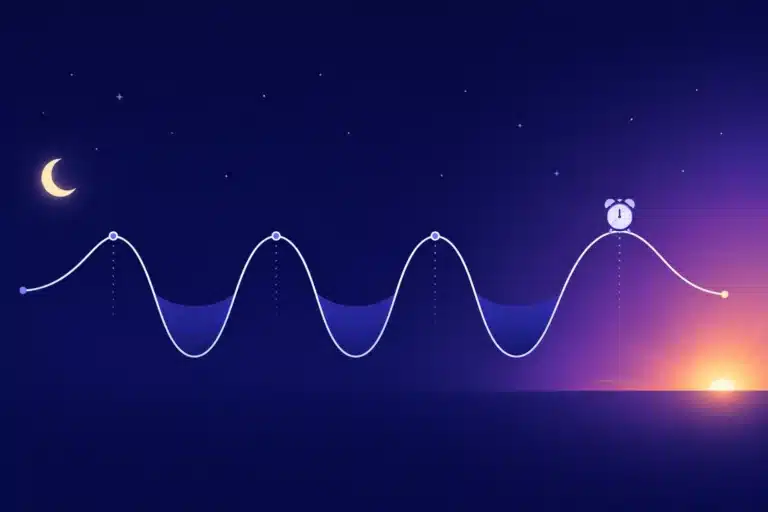
Sleep is not uniform. That it has structure at all was only established in 1953, when Aserinsky and Kleitman reported regularly recurring periods of eye movement during sleep in Science — the discovery of REM sleep, and the start of sleep science as a discipline. Sleep moves through cycles of light sleep, deep slow-wave sleep and REM sleep, each lasting roughly ninety minutes, repeated four to six times a night. The proportions shift as the night goes on: deep sleep dominates the early cycles, REM the later ones, which is part of why the last stretch before your alarm matters more than it feels like it should.
Waking at the end of a cycle, in light sleep, generally feels better than being pulled out of deep sleep mid-cycle — that heavy, disoriented feeling has a name, sleep inertia, and it can last twenty to thirty minutes. That is the entire logic behind cycle-based bedtime suggestions.
Two honest caveats. Ninety minutes is an average, and real cycles range from roughly seventy to a hundred and twenty minutes, varying between people and across a single night. And no clock can know where you are in a cycle. So treat these times as sensible targets rather than precision instruments — the aim is a whole number of cycles and enough total hours, and if you have to choose, total hours wins.
Which is why the previous version’s suggestion list was a real problem. It ran six, five, four and three cycles, and offered all four under a heading reading “Recommended times”. Three cycles is four and a half hours. That is below every published guideline for every age group, and presenting it as recommended is not a rounding issue. Options are now filtered against the band for your own age.
How the shortfall is measured, and against what
If you sleep less than the bottom of your age range, the tool shows the weekly shortfall. The important word is your range: the comparison is made against the same numbers printed on the page.
The previous build measured against a hardcoded eight hours regardless of what it had displayed. So an adult sleeping six and a half hours was told they were accumulating 10.5 hours of debt a week, when measured against the seven-hour bottom of the range the page itself showed, the shortfall is 3.5. At 65 and over the two disagreed outright — it printed a range of 7 to 9 and measured the debt against 7.5, neither of which is the published band for that age.
Consistency matters here because sleep debt is one of the few sleep concepts that is genuinely useful for planning. It is real, it accumulates, and the evidence is that it is not repaid by a single long weekend lie-in. Recovery from a sustained shortfall takes several nights of adequate sleep, and catching up only at weekends produces its own problem — a weekly shift in sleep timing sometimes described as social jetlag, which brings its own metabolic and mood costs.
Too much sleep is a finding, not a triumph
The old check was one comparison: if actual sleep was greater than or equal to the lower bound, the page printed “within the recommended range. Nicely done.” Twenty hours a night returned the same cheerful message as eight.
Regularly sleeping well beyond the range for your age is associated in observational studies with poorer health outcomes, though the direction of cause is genuinely unclear — long sleep is often a symptom of something else rather than a cause of it. Depression, sleep apnoea, thyroid disorders, anaemia, chronic pain, some medications and simply being unwell all lengthen sleep or fragment it so badly that more time in bed is needed to get the same rest.
So the useful reading of a high number is not that you are lazy or unusually well rested. It is that if you regularly need far more sleep than the range for your age and still wake unrefreshed, the sleep itself may not be doing its job, and that is worth a conversation with a doctor.
How long you take to fall asleep is diagnostic information
Healthy sleep onset takes roughly ten to twenty minutes. Falling asleep the moment your head touches the pillow, particularly under five minutes, is not a sign of a talent for sleeping — it more often indicates significant sleep deprivation.
At the other end, taking longer than thirty minutes to fall asleep, on three or more nights a week for three months or more, alongside daytime impairment, is one of the recognised diagnostic criteria for chronic insomnia disorder. The previous version of this page collected your latency and used it only to shift the suggested times. It is now assessed, and if your figure sits in that territory the page says what that means and suggests seeing someone about it.
The thirty-minute threshold is not something we invented for this page. It comes from the diagnostic criteria for chronic insomnia disorder set out in the third edition of the International Classification of Sleep Disorders, published by the American Academy of Sleep Medicine in 2014.
Worth knowing: the first-line treatment for chronic insomnia in current clinical guidance is cognitive behavioural therapy for insomnia, not medication. The American College of Physicians made that explicit in its clinical practice guideline in Annals of Internal Medicine in 2016, recommending CBT-I as the initial treatment for all adults with chronic insomnia. It is more effective in the long term than sleeping tablets and does not carry their dependence and tolerance problems.
What a bedtime calculator genuinely cannot do
It cannot see your chronotype. Genuine morning and evening preference is substantially genetic. If your body wants to sleep from one to nine, a calculator telling you to go to bed at ten will not change that, and lying awake for two hours is worse than a later bedtime.
It cannot detect a sleep disorder. Obstructive sleep apnoea, restless legs syndrome, narcolepsy and circadian rhythm disorders all produce poor sleep that no amount of arithmetic about bedtimes will fix. Loud snoring with witnessed pauses in breathing, or overwhelming daytime sleepiness despite adequate hours, both warrant medical assessment rather than a better bedtime.
It cannot measure sleep quality. Eight fragmented hours are not equivalent to seven solid ones, and time in bed is not time asleep.
It cannot fix shift work. Night and rotating shifts fight the circadian system directly. The general advice here does not translate, and occupational sleep guidance is a different discipline.
The things that actually improve sleep
Consistency does more than almost anything else — the same wake time every day, weekends included, anchors the circadian clock more effectively than any bedtime rule. Light is the strongest signal available to you: bright light early in the day, dim light in the evening. A cool, dark, quiet room helps, with somewhere around 16 to 19 °C usually cited. Caffeine has a half-life of roughly five to six hours, so an afternoon coffee is still measurably present at bedtime. Alcohol shortens sleep onset and then fragments the second half of the night and suppresses REM. And if you are awake and frustrated for more than about twenty minutes, getting up and doing something quiet in dim light is better than lying there teaching your brain that bed is where you worry.
What this page is not
It is arithmetic on published recommendations, and nothing on it is medical advice or a diagnosis. Persistent insomnia, loud snoring with pauses in breathing, severe daytime sleepiness, or sleep problems alongside low mood are all reasons to see a doctor rather than to adjust a bedtime. Sleep is closely tied to mental health in both directions; if that is part of the picture, it deserves proper attention rather than a schedule.
Nothing you enter is transmitted
Your age, times and sleep figures are used locally in your browser. Nothing is sent, stored or logged, there is no account, and the page continues to work with the connection off once loaded.
Questions people ask about sleep timing
How much sleep do I actually need?
Between 7 and 9 hours for adults aged 18 to 64, 7 to 8 from 65, and considerably more for children — up to 14 to 17 hours for newborns. The tool shows the band for the age you enter rather than one adult figure for everybody.
Is six hours enough if I feel fine on it?
For the large majority of people, no. The proportion of adults who genuinely function well on six hours or less is very small, and self-assessment is unreliable — performance measurably declines while subjective alertness does not. If you sleep six hours by choice, it is worth trying seven or eight for a fortnight before deciding.
Why does the tool suggest odd times like 22:37?
Because it works backwards in whole ninety-minute cycles from your wake time and then adds the minutes you said you take to fall asleep. Aiming to be in bed a few minutes before that is the intent.
Can I catch up on sleep at the weekend?
Partly, and not fully. Recovery from a sustained shortfall takes several nights, and shifting your timing at weekends creates its own problem by moving your body clock back and forth each week.
What if I take an hour to fall asleep?
Regularly taking more than thirty minutes, on three or more nights a week over three months, with daytime effects, is one of the criteria used to diagnose chronic insomnia disorder in the International Classification of Sleep Disorders (3rd edition, 2014). It is worth raising with a doctor. Cognitive behavioural therapy for insomnia is the recommended first-line treatment ahead of medication, per the American College of Physicians guideline of 2016.
Is it bad to sleep ten hours a night?
It is worth investigating rather than worth panicking about. Regularly sleeping well above your age band, especially while still waking unrefreshed, is often a symptom of something else — sleep apnoea, depression, thyroid problems or anaemia among them.
Do sleep cycles really last ninety minutes?
On average. Real cycles run roughly 70 to 120 minutes and vary between people and across the night, so cycle-based times are a sensible target rather than a precision instrument. If total hours and whole cycles conflict, choose total hours.
Does the age I enter change the recommended times?
Yes, and it should have before. The band, the suggested times and the shortfall are all derived from it, and options below the range for your age are no longer offered at all.
Do you store my sleep details?
No. Nothing is saved or transmitted.
Sources behind these numbers
- Hirshkowitz M et al, “National Sleep Foundation’s sleep time duration recommendations: methodology and results summary”, Sleep Health, March 2015 (PMID 29073412) — the nine age bands used here.
- Watson NF et al, “Recommended Amount of Sleep for a Healthy Adult: A Joint Consensus Statement of the American Academy of Sleep Medicine and Sleep Research Society”, Sleep, 2015 (PMID 26039963) — seven or more hours per night for adults.
- American Academy of Sleep Medicine, for the diagnostic criteria referenced on latency and insomnia.
- CDC — sleep, for the public-health framing and the US recommendations.
- NHS — sleep and tiredness, for UK guidance and when to seek help.
- Qaseem A et al, “Management of Chronic Insomnia Disorder in Adults: A Clinical Practice Guideline From the American College of Physicians”, Annals of Internal Medicine, 2016 (PMID 27136449) — CBT-I as first-line treatment.
- American Academy of Sleep Medicine, International Classification of Sleep Disorders, 3rd edition, 2014 — the diagnostic criteria referenced on sleep latency.
- Aserinsky E, Kleitman N, “Regularly occurring periods of eye motility, and concomitant phenomena, during sleep”, Science, 1953 (PMID 13089671) — the discovery of REM sleep, and the origin of sleep-cycle science.
- National Sleep Foundation.
Tools people open next to this one
- Calorie Calculator — daily intake targets, with safety floors.
- Diabetes Risk Calculator — sleep duration is an established risk factor for type 2 diabetes.