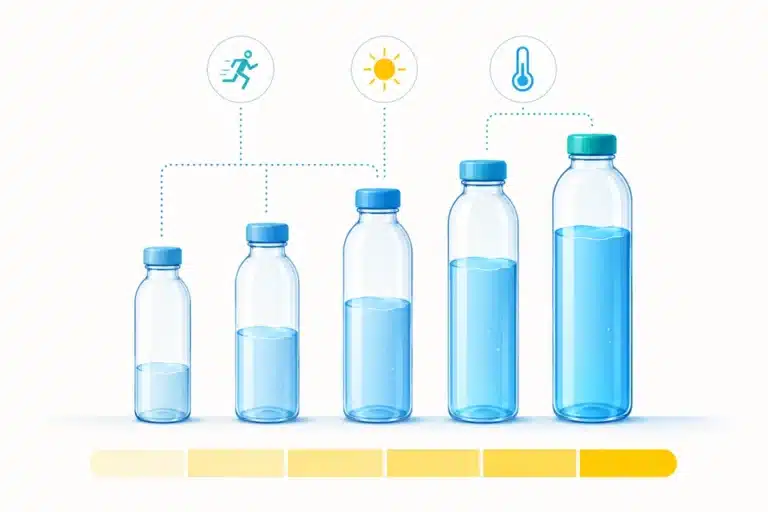
Working out a daily fluid figure that means something
1. Choose your sex
Not a formality. The two authorities that actually publish water intakes both separate men and women, and the gap is a full litre in one case. A calculator that cannot express a one-litre difference is not personalising anything, and the previous version of this page did not ask.
2. Enter your weight
Used for the per-kilogram cross-check rather than for the headline. Neither published reference intake is defined per kilogram, so body weight is shown here as a second opinion rather than as the answer — which is the reverse of how most calculators use it.
3. Add your exercise minutes
Continuous now, not stepped. In the previous build the add-on jumped in 350 ml blocks every thirty minutes, so fourteen minutes of exercise added nothing at all and forty-five minutes added 350 ml more than forty-four did. The figure now rises smoothly and is expressed as the range the ACSM actually publishes.
4. Say what the climate is like
Heat genuinely increases fluid needs. What it does not have is an official number: neither of the two reference bodies publishes a numeric heat increment. The tool still offers one, because a blank helps nobody, and labels it clearly as a rule of thumb rather than dressing it up as a guideline.
5. Read both figures, total and from drinks
The published intakes are for total water, which includes what you get from food. Roughly a fifth of most people’s intake arrives that way. The tool shows total water and water from drinks separately instead of printing one and leaving you to do the subtraction in a footnote.
6. Check the upper bound as well as the target
More is not better without limit, and this page now says so. The kidneys can clear roughly 0.8 to 1.0 litres an hour; drink faster than that for long and blood sodium falls. The tool flags a figure that has climbed into territory worth questioning rather than printing it without comment.
Where a daily water figure legitimately comes from
Two bodies publish reference intakes, and they are the anchor for everything on this page.
The US National Academies — then the Institute of Medicine, now the National Academies of Sciences, Engineering, and Medicine — published Dietary Reference Intakes for water in 2004. It set adequate intake for total water at 3.7 litres a day for adult men and 2.7 litres for adult women. Total water means everything: drinks of all kinds plus the water contained in food. The report estimated that roughly twenty per cent of total intake typically comes from food, which puts the drinks portion at about 3.0 litres for men and 2.2 litres for women.
The European Food Safety Authority published its adequate intakes in 2010 and arrived at lower figures: 2.5 litres a day of total water for men and 2.0 litres for women, under moderate environmental conditions and moderate physical activity.
Both are shown here, because the difference between them is honest information. These are population reference values derived from observed intakes in healthy groups, not physiological requirements measured in individuals, and two expert committees looking at overlapping evidence landed more than a litre apart for men. Anyone presenting a single authoritative daily figure to the millilitre is overselling what this science supports.
Why the old 35 ml per kilogram rule was the wrong anchor
The previous version of this page built its answer on 35 millilitres of water per kilogram of body weight. That figure is real, and it comes from clinical practice — it is the sort of rule used for planning fluid provision in tube feeding and inpatient care. It is not a dietary recommendation for healthy adults, and neither of the two authorities above works per kilogram at all.
The compounding error was what got added on top. The old build applied the EFSA lactation increment of 700 ml to that per-kilogram base. That increment is defined against EFSA’s own per-person adequate intake; bolted onto a per-kilogram figure derived from an unrelated clinical rule, it is arithmetic without meaning — two numbers from different systems added because both happened to be about water.
The published intakes are now the anchor, both of them, and the per-kilogram rule appears as a clearly labelled cross-check. When the two broadly agree you can be reasonably confident. When they diverge, that tells you something too. There was also a plainer problem: the tool’s own page copy said about 33 ml/kg while the tool used 35, and neither of them said where either figure came from.
Exercise, and the range the ACSM actually gives
Fluid lost during exercise varies enormously — by individual, intensity, temperature, humidity, clothing and how well acclimatised you are. Sweat rates across ordinary exercising adults span roughly 0.5 to 2.0 litres an hour, and the extremes go further.
The American College of Sports Medicine’s position stand on exercise and fluid replacement, published in Medicine & Science in Sports & Exercise in February 2007, remains the standard reference. Its central practical point is that fluid replacement should be individualised, and that the most reliable way to work out your own rate is to weigh yourself before and after a session: each kilogram lost is approximately one litre of fluid.
So the exercise figure here is offered as a range rather than a single number, and it now rises continuously with the minutes you enter. The old step function was a small defect with a silly consequence — a fourteen-minute session counted for nothing, and a forty-fifth minute was worth 350 ml more than the forty-fourth.
Heat, humidity and the number nobody publishes
Hot weather increases fluid needs, sometimes dramatically. Humidity makes it worse, because sweat that cannot evaporate cools you less while still costing you the fluid. Altitude increases losses through faster breathing and drier air.
What does not exist is an official increment. Neither the National Academies nor EFSA publishes “add this many millilitres for a hot climate”, because the honest answer depends on temperature, humidity, acclimatisation, clothing and what you are doing. The previous build printed 500 ml and 850 ml for warm and hot conditions with no source at all; those numbers were invented.
This page still offers a figure, because leaving the field blank helps nobody, and labels it as the rule of thumb it is. If you live somewhere genuinely hot, your own thirst and urine colour over a week are better instruments than any fixed addition.
You can drink too much, and this page will tell you so
This is the section the previous version was missing entirely. At 150 kg in a hot climate, the old tool would recommend 6.8 litres a day and say nothing about it.
Healthy kidneys can excrete roughly 0.8 to 1.0 litres of water an hour. Drink substantially faster than that for a sustained period and blood sodium is diluted — a condition called hyponatremia. Early symptoms are unhelpfully vague: headache, nausea, confusion, bloating. Severe cases cause brain swelling, seizures and death. Exercise-associated hyponatremia is well documented among endurance athletes, and its usual cause is not underdrinking but overdrinking during long events, often by people carefully following advice to stay ahead of thirst.
The tool now shows an upper bound alongside the target and flags a figure that has climbed into territory worth questioning. If you find yourself needing far more than the reference intakes suggest, that is worth mentioning to a doctor rather than simply drinking more — persistent unusual thirst is a recognised early sign of several conditions, diabetes among them.
Total water and water from drinks are not the same number
Roughly a fifth of most people’s water intake comes from food. Cucumber, lettuce, tomato, melon and strawberry are over ninety per cent water; soup, yoghurt, rice and pasta all contribute meaningfully.
The old page printed a per-kilogram total and added a footnote saying about twenty per cent comes from food so drink a little less, leaving the visitor to do the arithmetic. Both figures are now given, because they answer different questions. Total water is what you compare against the published reference intakes. Water from drinks is what you can actually act on when you fill a bottle.
On what counts: essentially all drinks count toward hydration, including tea and coffee. The idea that caffeinated drinks are net dehydrating does not survive contact with the evidence at ordinary intakes — the mild diuretic effect is smaller than the volume of fluid you drank to get it. Alcohol is the genuine exception, since it suppresses vasopressin and increases urine output.
Better signals than any calculator
Urine colour. Pale straw is the target. Dark yellow suggests drinking more; completely colourless all day, particularly with frequent trips to the toilet, may mean you are drinking more than you need.
Thirst. A reliable guide for healthy adults under ordinary conditions, and better than a schedule. It becomes less reliable in older adults, during hard exercise and in extreme heat, which is when a target figure earns its place.
Weight change across a session. One kilogram lost is roughly one litre of fluid, and it is the most accurate personal measurement available to you without a laboratory.
When a general figure does not apply to you
Nothing here is medical advice. Several conditions change fluid needs in directions a general calculator cannot model, sometimes toward strict restriction rather than more.
Please follow clinical advice rather than this page if you have heart failure, kidney disease or are on dialysis, liver disease with fluid retention, or are taking diuretics or lithium. The same applies during pregnancy and breastfeeding, both of which raise requirements meaningfully, and for young children and frail older adults, whose needs and thirst signals differ. If you are unwell with fever, vomiting or diarrhoea, oral rehydration solution addresses electrolyte loss in a way plain water does not.
Nothing you enter is transmitted
Sex, weight, exercise minutes and climate are used locally in your browser to compute the figures. Nothing is sent, stored or logged, and the page keeps working with the connection off once loaded.
Questions people ask about daily water intake
Is it really eight glasses a day?
No, and the origin of the claim has been traced. Heinz Valtin, a kidney physiologist, went looking for the evidence behind “8 x 8” and published the result in the American Journal of Physiology in November 2002: he could find no scientific basis for it, and concluded that healthy adults in temperate climates meeting ordinary demands are very likely getting enough without following the rule. The figure appears to be a misreading of a 1945 US Food and Nutrition Board recommendation, which suggested roughly 2.5 litres a day and noted in the very next sentence that most of it is contained in prepared foods. The published reference intakes are 3.7 and 2.7 litres of total water (National Academies) or 2.5 and 2.0 litres (EFSA), for men and women.
Why do the two authorities disagree by more than a litre?
Because both are derived from observed intakes in healthy populations rather than from a measured physiological requirement, and they looked at different populations with different methods. The disagreement is genuine and worth seeing rather than hiding behind one number.
Do tea and coffee count?
Yes. At ordinary intakes the mild diuretic effect of caffeine is outweighed by the fluid volume itself. Alcohol is the real exception.
How much water should I drink per kg of body weight?
It is the wrong question, strictly speaking — neither published reference intake is defined per kilogram. The 30 to 35 ml/kg rule comes from clinical fluid planning. It is shown here as a cross-check because it is useful for sanity, not because it is the standard.
Can drinking too much water be harmful?
Yes, and occasionally fatally. Kidneys clear roughly 0.8 to 1.0 litres an hour; exceeding that for a sustained period dilutes blood sodium. Exercise-associated hyponatremia usually results from overdrinking during long events, not from drinking too little.
How much extra should I drink when exercising?
Enough to replace what you lose, which is individual. Weigh yourself before and after a session: one kilogram lost is about one litre. For sessions beyond roughly an hour, or in heat, electrolytes matter as well as volume.
Does the tool account for hot weather properly?
It offers a figure and tells you honestly that no authority publishes one. Heat genuinely raises needs; the size of the increase depends on too many variables for a fixed number to be trustworthy.
Should I drink to a schedule or to thirst?
Thirst is reliable for most healthy adults in ordinary conditions. A schedule helps during long exercise, in extreme heat, and for older adults, in whom the thirst signal weakens with age.
Do you store my details?
No. Nothing is saved or transmitted.
Sources behind these numbers
- Institute of Medicine / NASEM — Dietary Reference Intakes for Water, Potassium, Sodium, Chloride, and Sulfate, 2004, for the 3.7 and 2.7 litre total-water figures and the roughly 20% from food.
- European Food Safety Authority — scientific opinion on dietary reference values for water, 2010, for the 2.5 and 2.0 litre figures.
- American College of Sports Medicine position stand, “Exercise and fluid replacement”, Medicine & Science in Sports & Exercise, February 2007 (PMID 17277604) — individualised replacement, and the weigh-before-and-after method.
- NHS — water, drinks and your health, for the UK framing and what counts as fluid.
- CDC — water and healthier drinks.
- Valtin H, “Drink at least eight glasses of water a day. Really? Is there scientific evidence for 8 x 8?”, American Journal of Physiology — Regulatory, Integrative and Comparative Physiology, November 2002 (PMID 12376390) — the review that went looking for the evidence behind the eight-glasses rule and did not find any.
Tools people open next to this one
- Calories Burned Calculator — for the session driving the extra fluid.
- Sleep Calculator — the other daily input people most often get wrong.
- Heart Rate Calculator — training intensity, which drives sweat rate more than duration does.