“Drink eight glasses of water a day” is one of the most repeated pieces of health advice in existence, and nobody can point to the guideline it came from. Meanwhile a 55 kg office worker in a cool climate and a 95 kg bricklayer in July are told the same number. Here is how much fluid you actually need, why it depends on your body weight and what you do all day, and the situations where drinking more is genuinely a bad idea.
Quick answer: a practical starting point for healthy adults is about 35 ml of fluid per kilogram of body weight per day — roughly 2.5 litres for someone weighing 70 kg — plus extra for exercise and hot weather. The Water Intake Calculator does the arithmetic and adds the adjustments for you.
1Start from your body weight
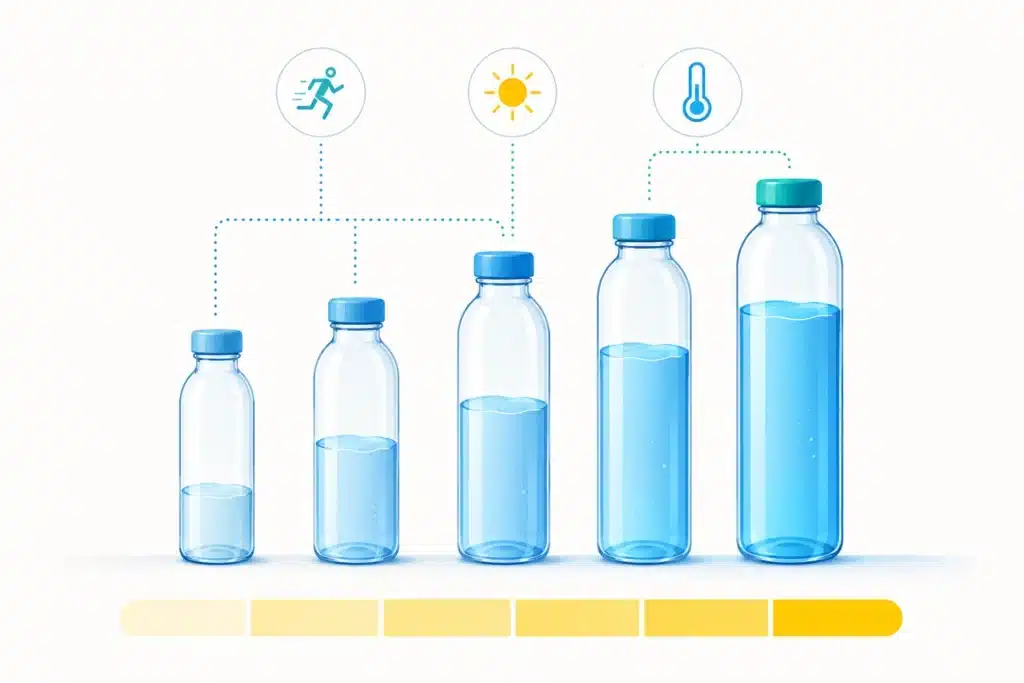
Bigger bodies hold more water, lose more through the skin and breath, and need more to replace it. Weight-based estimates are therefore a far better starting point than a fixed number of glasses:
| Body weight | Baseline fluid (≈35 ml/kg) | 250 ml glasses |
|---|---|---|
| 50 kg | ≈ 1.8 litres | ≈ 7 |
| 60 kg | ≈ 2.1 litres | ≈ 8 |
| 70 kg | ≈ 2.5 litres | ≈ 10 |
| 80 kg | ≈ 2.8 litres | ≈ 11 |
| 90 kg | ≈ 3.2 litres | ≈ 13 |
| 100 kg | ≈ 3.5 litres | ≈ 14 |
You will see other rules of thumb in the 30–35 ml/kg range; they are all approximations of the same idea. This is a target for total daily fluid, and about 20% of what most people take in arrives through food — soups, fruit, vegetables, yoghurt, rice — so the amount you actually have to drink is usually a little lower than the figure above.
2Then add for what you do
The baseline assumes an ordinary day in an ordinary climate. Three things move it meaningfully:
| Situation | Add roughly | Why |
|---|---|---|
| Exercise | +350 ml per 30 minutes | Sweat losses; heavy sweaters and long sessions need more |
| Hot or humid weather | +500 ml or more | Higher sweat rate even at rest |
| Pregnancy | +300 ml | Increased blood volume and amniotic fluid |
| Breastfeeding | +700 ml | Milk production draws directly on body fluid |
| Fever, vomiting, diarrhoea | Case by case | Losses can be rapid — seek advice if it persists |
So the 70 kg example who trains for an hour lands near 3.2 litres for the day rather than 2.5. That is the whole point of calculating it rather than reciting a number: your target on a training day in August is not your target on a rainy Tuesday at a desk.
3Where “eight glasses” came from
Eight 250 ml glasses is two litres, which is not far off the baseline for a smaller adult — so the advice is not harmful, it is just blunt. It ignores body size, activity, climate and the substantial contribution of food. The NHS does suggest aiming for 6 to 8 cups or glasses of fluid a day, but it presents that as a general benchmark alongside a far more useful instruction: drink enough that your urine stays a pale, clear yellow.
What the evidence base does give us is an adequate intake for total daily water from all sources — food and drink combined. The US National Academies of Sciences, Engineering, and Medicine put that at about 3.7 litres a day for men and 2.7 litres for women. Subtract the share that comes from food and you land at roughly 3.0 and 2.2 litres of actual drinking, which is comfortably in the same territory as the weight-based estimate above.
4The signals that beat any calculator
- Urine colour. Pale straw is the everyday target. Deep yellow or amber usually means drink more. Very clear, all day, may mean you are drinking more than you need.
- Thirst. For healthy adults under normal conditions it is a reliable prompt. It becomes less reliable with age, which is one reason older adults are advised to drink to a schedule rather than waiting for it.
- Headache, fatigue, poor concentration. Common early signs of mild dehydration — worth a glass of water before reaching for anything else.
- Dry mouth, dizziness on standing, dark urine together. More significant dehydration; act on it, and seek medical help if it does not resolve.
What counts toward the total
Water, milk, juice, soup, tea and coffee all contribute. The idea that caffeinated drinks dehydrate you does not hold up at ordinary intakes — the fluid in a cup of tea more than offsets its mild diuretic effect. Alcohol is the genuine exception: it increases fluid loss, which is why hangovers and dehydration travel together. Sugary drinks count as fluid but bring the sugar with them, and the WHO advises keeping free sugars under 10% of daily energy.
5When more water is the wrong answer
Hydration is not a “more is always better” metric. Drinking very large volumes quickly can dilute blood sodium — a condition called hyponatraemia that is rare but genuinely dangerous, and best known among endurance athletes who drink heavily during long events. Spread intake through the day rather than forcing litres at once.
More importantly, some people are medically advised to restrict fluid: certain heart, kidney and liver conditions, and some medications, come with a specific daily limit. If a doctor has given you one, that limit overrides every calculator on the internet, including ours.
6Making it happen
The Water Intake Calculator takes your weight, exercise minutes, climate and any pregnancy or breastfeeding adjustment, and returns a daily litre target, the equivalent in glasses, and a simple eight-slot schedule across the day. A few habits that make the target stick:
- Start with a glass on waking. You finish the night mildly dehydrated, and it anchors the habit at a fixed point.
- Attach drinking to existing events. A glass with every meal, one before each coffee, one on arriving anywhere.
- Keep a bottle you can see. Visible bottles get drunk; bottles in bags do not.
- Drink around training, not just after. Sipping through a session beats trying to catch up afterwards.
Educational information, not medical advice. These figures are general guidance for healthy adults. Children, older adults, pregnant and breastfeeding people, athletes in extreme conditions, and anyone with heart, kidney or liver disease have different needs — follow your clinician’s advice over a general estimate.
7Frequently Asked Questions
How much water should I drink a day based on my weight?
A practical baseline is about 35 ml per kilogram of body weight — roughly 2.1 litres at 60 kg, 2.5 litres at 70 kg and 2.8 litres at 80 kg — then add around 350 ml for every 30 minutes of exercise and more in hot weather.
Is 8 glasses of water a day actually a guideline?
No. It is a popular rule of thumb rather than an official recommendation. Eight 250 ml glasses is two litres, which happens to be reasonable for a smaller adult but ignores body weight, activity, climate and the fluid you get from food.
Do tea and coffee count toward my daily water intake?
Yes. At normal intakes the fluid in tea and coffee outweighs their mild diuretic effect, so they contribute to your total. Alcohol is the exception — it increases fluid loss rather than replacing it.
How do I know if I’m drinking enough?
Pale straw-coloured urine through the day is the simplest everyday indicator, alongside not feeling persistently thirsty, headachy or foggy. Consistently dark urine suggests you need more.
Can you drink too much water?
Yes, though it is uncommon. Drinking very large volumes in a short time can dilute blood sodium, a condition called hyponatraemia. Spread your intake across the day, and follow any fluid restriction your doctor has given you.