
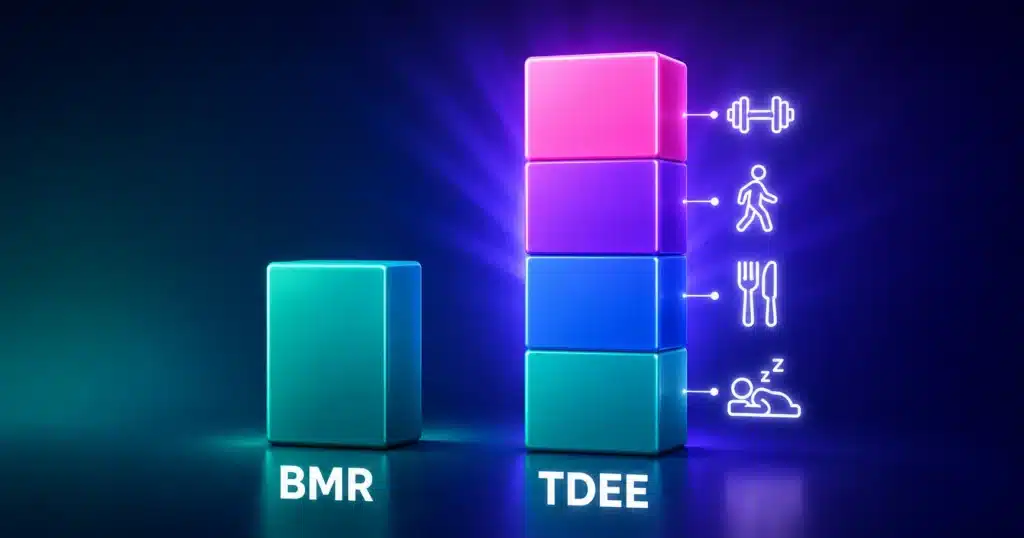
Every calorie calculator throws two acronyms at you within about three seconds, and most never explain the difference. BMR and TDEE are not competing numbers — one is an input to the other, and knowing which is which is the difference between a target you can eat and a target that leaves you starving by 4pm.
In one line: BMR is the energy your body burns doing absolutely nothing; TDEE is BMR plus everything you actually do in a day. TDEE is the number you eat against — never BMR. Get both from the free BMR & TDEE Calculator.
1BMR: the cost of simply existing
Basal Metabolic Rate is the energy required to keep you alive at complete rest — heart beating, lungs working, kidneys filtering, brain running, body temperature held steady. Measured properly it involves lying still in a lab after an overnight fast, which is why almost everyone estimates it from a formula instead.
It is also, for most people, the biggest single component of daily energy use: commonly around 60–70% of the total for someone who is not especially active. That surprises people who assume exercise dominates. It rarely does.
You will also see RMR (Resting Metabolic Rate) used almost interchangeably. RMR is measured under less strict conditions and typically comes out slightly higher than true BMR. For everyday planning the difference is small enough to ignore.
2TDEE: what you actually burn
Total Daily Energy Expenditure is everything, added up:
| Component | What it covers | Roughly |
|---|---|---|
| BMR | Keeping you alive at rest | 60–70% of TDEE |
| Thermic effect of food | Digesting and processing what you eat | About 10% |
| Deliberate exercise | Training, sport, the gym | 0–30%, highly variable |
| Everything else you do | Walking, chores, standing, fidgeting | The wildcard — can vary hugely between people |
Calculators collapse the last three into a single activity multiplier applied to BMR. It is a blunt instrument, but it is the practical one.
3The formulas, and when each one fits
The BMR & TDEE Calculator runs several equations side by side so you can see the spread rather than trusting a single output:
| Formula | Uses | Best for |
|---|---|---|
| Mifflin–St Jeor | Weight, height, age, sex | The default for most adults — generally the most accurate of the height-and-weight formulas |
| Harris–Benedict | Weight, height, age, sex | The historical standard; usually reads a little higher than Mifflin |
| Katch-McArdle | Lean body mass | People who know their body-fat percentage, especially lean or muscular ones |
| Cunningham | Lean body mass | Trained athletes; typically the highest of the four |
Mifflin–St Jeor is the one to use if you have no body-fat measurement:
Men: (10 × kg) + (6.25 × cm) − (5 × age) + 5
Women: (10 × kg) + (6.25 × cm) − (5 × age) − 161
The lean-mass formulas ignore height, age and sex entirely and work from the tissue that actually burns energy. Katch-McArdle is 370 + (21.6 × lean body mass in kg). That is why two people of identical weight can have genuinely different BMRs: the one carrying more muscle burns more at rest.
A worked example
A 28-year-old man, 178 cm, 75 kg, with 18% body fat:
| Formula | Working | BMR |
|---|---|---|
| Mifflin–St Jeor | 750 + 1,112.5 − 140 + 5 | ≈ 1,728 kcal |
| Katch-McArdle | Lean mass 61.5 kg → 370 + (21.6 × 61.5) | ≈ 1,698 kcal |
Thirty calories apart — close enough that either is a fine starting point. When the formulas disagree sharply, it is usually a sign that your body composition is unusual for your height and weight, and the lean-mass version is the one to trust.
4The activity multiplier is where people go wrong
Taking that 1,728 kcal BMR, here is what each activity level produces:
| Level | × | What it honestly means | TDEE |
|---|---|---|---|
| Sedentary | 1.2 | Desk job, little or no deliberate exercise | ≈ 2,074 kcal |
| Lightly active | 1.375 | Light exercise 1–3 days a week | ≈ 2,376 kcal |
| Moderately active | 1.55 | Moderate exercise 3–5 days a week | ≈ 2,678 kcal |
| Very active | 1.725 | Hard exercise 6–7 days a week | ≈ 2,981 kcal |
| Extra active | 1.9 | Physical job or two training sessions a day | ≈ 3,283 kcal |
That is a 1,200-calorie spread from one honest question. Over-rating your activity is the single most common reason a calculated target fails to produce results. Three gym sessions a week plus a desk job is lightly to moderately active — not “very active”. If you are unsure, pick the lower level: it is far easier to add food once progress is steady than to discover months later that your baseline was fiction.
5Using the two numbers
- Losing fat: subtract 10–20% from TDEE. The calculator shows a −500 kcal target, which predicts about 0.45 kg a week. Full detail in our calorie deficit guide.
- Maintaining: eat at TDEE and let a fortnight of weigh-ins tell you whether the estimate was right. If your weight drifts, adjust by about 100–150 kcal and wait again.
- Building muscle: a modest surplus — the tool suggests around +250 kcal — with resistance training and roughly 1.8 g of protein per kg of body weight. Bigger surpluses mainly add fat.
- Never eat below BMR by design. BMR is a floor, not a target. If a plan puts you under it, the plan is wrong.
6How accurate are these numbers, really?
Honestly: they are estimates, and a good one still carries roughly ±10% of error for an individual. Age, genetics, thyroid function, medication, sleep, past dieting history and how much you unconsciously move all shift the real figure. Someone whose true TDEE is 2,400 might be handed a 2,650 estimate — enough to explain a stall.
Treat the calculator’s output as a starting hypothesis. Eat at it consistently for two to three weeks, track weight and how you feel, and let the trend correct the estimate. Real data from your own body beats any equation.
Educational information, not medical advice. Energy equations are population averages and are not diagnostic. If you have a thyroid, metabolic or eating-related condition, are pregnant or breastfeeding, or are under 18, plan intake with a doctor or registered dietitian.
7Frequently Asked Questions
What is the difference between BMR and TDEE?
BMR is the energy your body uses at complete rest to stay alive. TDEE is BMR plus digestion, exercise and all the incidental movement of a normal day. TDEE is always the larger number and is the one you set calorie targets against.
Should I eat my BMR or my TDEE?
Your TDEE, adjusted for your goal. Eating at BMR means eating as though you spend the entire day motionless, which creates a much larger deficit than intended and is hard to sustain.
Which BMR formula is the most accurate?
Mifflin–St Jeor is generally the most reliable when you only know height, weight, age and sex. If you have a decent body-fat measurement, Katch-McArdle is usually better because it works from lean mass, which is what actually drives resting energy use.
Does BMR decrease with age?
Yes, gradually — partly because of ageing itself and partly because muscle mass tends to fall over the years. Resistance training slows the muscle side of that decline, which is one reason it is recommended well into later life.
Why is my TDEE different on other calculators?
Different sites use different equations and different activity multipliers, so a 100–300 kcal spread between calculators is normal. Pick one, use it consistently, and adjust based on how your weight actually responds over a few weeks.