User Guide
Type your letters
Enter up to 20 letters — the box accepts A–Z and the ? wildcard and quietly strips anything else, so you can paste straight from a puzzle without tidying up first. Press Enter or hit Unscramble. The chips beside the box let you Shuffle your letters, drop in a Random set to play with, or Clear and start again.
Use ? for a blank tile
Each ? stands for any single letter, exactly like a blank Scrabble tile. It widens the search enormously: TRAIN returns 36 words, while TRA?N returns 297. Two wildcards widen it further still, which is why blanks are best paired with the filters below.
Narrow it with Advanced Filters
Set a minimum and maximum length — the minimum starts at 3, so drop it to 2 if you want the two-letter plays — and require the word to start with, end with or contain a given run of letters. This is the combination that turns a word list into a puzzle answer: five letters, starting CR, containing A.
Switch on Everyday words only when the list gets strange
The solving dictionary is a word-game lexicon, so it legitimately contains entries like santir and instar. Ticking Everyday words only hides the obscure, technical and archaic ones: TRAINS drops from 118 results to 61, and PUZZLE from 17 to just PUZZLE itself. It is off by default because the full list is what a player wants.
Read the bands
Results arrive longest-first in coloured bands — one band per word length, with the count in the corner — and every word carries its Scrabble score, calculated from the standard letter values. The four cards above the bands give you the totals at a glance: words found, longest word, average length and top score.
Tap a word, then take the list with you
Click any result for its definition, phonetic spelling, UK and US pronunciation audio, examples and synonyms. A word the dictionary does not recognise is marked with a dashed underline, so obscure entries are visible at a glance rather than trusted by mistake. The search box filters the results you already have, and Copy all and Download .txt take the whole list with you.
About the Word Unscrambler
Give the Word Unscrambler a handful of letters and it returns every English word those letters can spell — not just the longest one, but all of them, sorted longest first, banded by length and priced with a Scrabble score. It is built for the moment you are stuck: seven tiles and no idea what they make, a crossword clue with two letters filled in, a newspaper jumble that will not crack, or a five-letter guess that has to fit what you already know.
It is deliberately not a black box. The filters let you describe the shape of the answer you need, the results tell you how many there are and how long the longest is, and a single tap gives you the definition — so you can check a word before you play it rather than gamble on a list.
The dictionary behind it, and why the size is not the headline
The solver runs against a curated list of 270,715 English words. That is smaller than the lists many unscramblers advertise, and the difference is the point. We previously used a 359,000-entry word-game list and replaced it, because measuring it showed what “bigger” was actually buying: 322 of its 427 two-letter entries were not words at all (ac, af, aq, az, bb, cf), and roughly 47% of the whole file was obsolete filler and proper nouns — mythohistoric, bedcap, aaron, naples. Worse, it was missing 80,876 legitimate words the curated list has, including qi and oi, so those could never be returned at any setting.
The list in use now contains inflections, excludes proper nouns and acronyms, and was topped up in August 2026 with modern vocabulary an older lexicon lacks — emoji, selfie, wifi, bitcoin, paywall, deepfake, clickbait. A bigger number on a marketing page is easy. A list where the results are words is more useful.
Everything is solved on your own device
The dictionary downloads once — about 680 KB compressed — and is then cached by your browser. From that point every search is answered locally: your letters are never sent anywhere, there is no per-query request, no rate limit and no queue, and the tool keeps working if your connection drops. It is also why results appear instantly rather than after a round trip, even for a set of letters that returns several hundred words.
One precise exception, so the privacy claim is not oversold: tapping a word for its definition sends that single word to the open dictionary API that supplies the meanings and audio. Solving is local; looking a word up is not. If that matters for what you are doing, simply do not tap.
A worked example, with the real numbers
Enter PLANETS at the default settings and the tool returns 265 words: an average length of 4.2 letters, a top Scrabble score of 9, and two seven-letter answers that use every tile — PLANETS and PLATENS, both worth 9 points. Below them sit 20 six-letter words, 79 of five letters, 103 of four and 61 of three.
Tick Everyday words only and the same letters return 157 words. The six-letter band becomes the one you would actually play — panels, pastel, petals, planes, planet, plants, plates, pleats, staple — and PLATENS, a genuine word for the roller in a typewriter, drops away with it. Neither list is the “right” one; the switch simply chooses between a player’s list and a reader’s list.
The same effect at its most dramatic: PUZZLE returns 17 words normally, and exactly one with the filter on. There were never seventeen useful words in PUZZLE — there were sixteen obscure ones and the word itself, worth 26 points.
What a wildcard really does
A ? is a blank tile: it can become any of the 26 letters, and the solver allows one substitution per wildcard. That is a much larger change than it looks. TRAIN yields 36 words; change the I to a blank — TRA?N — and you get 297, with the top score jumping from 5 to 14 as high-value letters become reachable. Two wildcards multiply that again.
The practical technique is to pair a wildcard with a filter rather than reading the whole flood. If you know the word is five letters and ends in -NT, set both, and 297 results become a shortlist you can scan in seconds. Wildcards find the possibilities; the filters find the answer.
Using it for Scrabble, Wordle, crosswords and jumbles
Scrabble and Words With Friends: enter your rack, use starts with or contains to hook onto a letter already on the board, and read the score on each chip — those are the standard letter values, so the number is a real comparison between plays. What it cannot tell you is the board: premium squares, and the multiplier a word lands on, are yours to judge. Our Scrabble Word Finder is the same engine framed around tiles and scores.
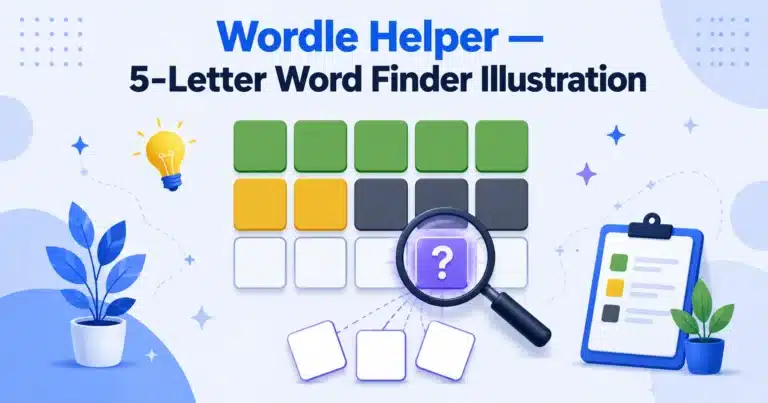
Wordle: set both length sliders to 5, then feed in what you know — starts with for confirmed green letters at the front, contains for a yellow letter you know is in there, ends with for a confirmed tail. Treat the output as candidates rather than answers: Wordle draws from a curated list of around 2,300 everyday solutions, while our dictionary is far broader, so tick Everyday words only to get closer to the kind of word the puzzle actually uses. Our Wordle Helper is built specifically for that pattern.
Crosswords: the three pattern filters map directly onto the letters you have already filled in, and the length sliders onto the number of squares. Jumbles and anagram puzzles: the newspaper kind usually wants a word that uses every letter, which is what the Anagram Solver is for; use the Jumble Solver when you want the full answer plus the shorter words that helped you spot it.
Which of the word tools you actually want
All six share this dictionary and this results view, and they differ only in the question they ask. The Word Unscrambler finds words of any length from your letters — the general case, and the one to start with. The Anagram Solver returns only words that use every letter you typed. The Jumble Solver drops the minimum length to 2 and leads with the full-length answer, which is how jumble puzzles are set. The Word Generator works the other way round, producing random words to a pattern instead of solving one. The Word Combiner joins two lists and flags the joins that turn out to be real words — sun + flower, rain + bow. And the Scrabble Word Finder is the unscrambler dressed for a game board.
Being honest about what a word list can and cannot promise
Our dictionary is derived from an open spell-checking lexicon. It is not the official Scrabble tournament word list — neither TWL nor Collins, both of which are copyrighted and not used here — so a word appearing in these results is not a guarantee that a tournament adjudicator will accept it. The Scrabble scores are exact, because they are simple sums of the standard letter values; it is only validity in formal play that we cannot vouch for.
Two smaller consequences worth knowing. Proper nouns are excluded on purpose, so LONDON, JAMES and CHRISTMAS will never appear no matter which letters you enter — correct for a word game, occasionally surprising if you were hoping to unscramble a name. And the minimum length starts at 3, so the two-letter plays that often win a tight Scrabble endgame are hidden until you move the slider down: TRAINS returns 118 words at the default, and 131 when you allow two-letter words.
Finally, the dashed underline. If you tap a word and the dictionary has no entry for it, that word’s chip is marked with a muted dashed underline for the rest of the session — a quiet signal that the word is in the list but not in the dictionary, and that you may want to check before playing it. Most tools hide that distinction. Showing it is the point.
Frequently Asked Questions
What is a word unscrambler, and what counts as a word?
It takes a set of jumbled letters and returns every English word those letters can spell, sorted longest first. Ours checks your letters against a curated 270,715-word dictionary that includes inflections but excludes proper nouns and acronyms, so results are words rather than abbreviations or names.
How many letters can I enter, and how long can the results be?
You can type up to 20 letters, including wildcards. Results are capped at 15 letters by the maximum-length slider, which is longer than any word most puzzles will need. Longer inputs simply give the solver more material to work with; they do not slow it down noticeably.
Why aren’t two-letter words showing in my results?
The minimum length starts at 3, because two-letter results are mostly noise when you are looking for a play. Open Advanced Filters and drag the minimum down to 2 to see them — with the letters TRAINS that takes the result count from 118 to 131, and those thirteen extra words are exactly the ones that win close endgames.
What does “Everyday words only” actually remove?
It hides obscure, technical and archaic entries, keeping words you would expect to meet in ordinary reading. TRAINS goes from 118 results to 61, and its six-letter band from four words to STRAIN and TRAINS. PUZZLE goes from 17 words to one. It is off by default because word-game players usually want the full list.
Some results have a dashed underline. What does that mean?
That word is in our word list, but the dictionary we use for definitions has no entry for it. The mark appears after you tap the word and stays for the rest of your session. Treat those results with care — they are the ones most likely to be challenged in a game.
Are these words valid in Scrabble tournaments?
Not guaranteed. Our dictionary comes from an open spell-checking lexicon, not from the official TWL or Collins tournament lists, which are copyrighted. The point scores shown on each word are exact, since they are sums of the standard letter values — it is only formal validity that we cannot promise.
Can I use it to solve Wordle?
Yes. Set both length sliders to 5 and enter what you know: starts with for confirmed opening letters, contains for a letter you know is present, ends with for a confirmed ending. Tick Everyday words only, because Wordle draws from about 2,300 common solutions while our dictionary is far broader.
Is my input sent to a server?
No. The dictionary downloads once, roughly 680 KB compressed, and every search after that is solved inside your browser with no request at all — so it keeps working offline. The one exception is tapping a word for its definition, which asks an open dictionary API about that single word.
Why does another site find more words from the same letters?
Because it is using a different, usually much larger, word list. Bigger lists are padded with obsolete entries, abbreviations and proper nouns — the 359,000-word list we used previously turned out to have 322 non-words among its 427 two-letter entries. We chose a smaller list whose results hold up when you look them up.
I need words that use every one of my letters. Is this the right tool?
Use the Anagram Solver instead — it returns only full-length answers, so nothing shorter clutters the list. Stay here when you want every word of every length, which is what you need for Scrabble racks, crossword squares and any puzzle where the shorter words matter too.