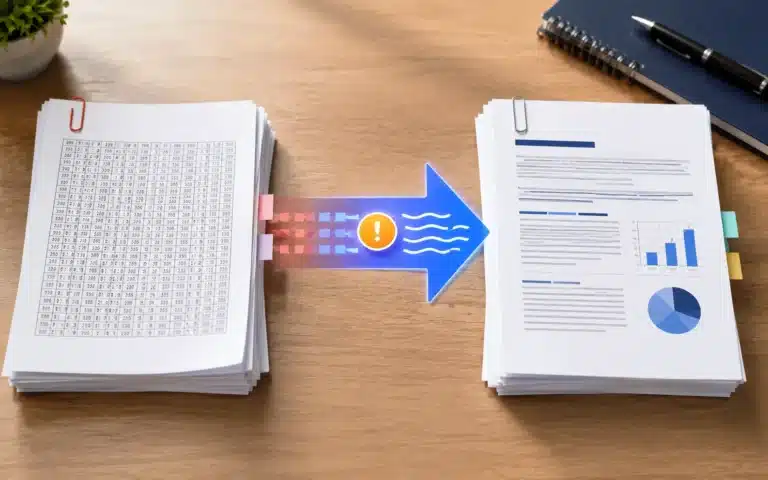
PDF to XLSX
Convert PDF tables into structured Excel (.xlsx) format.
Drag & drop your PDF here
or click to select file
User Guide
Check the PDF has real tables
This works on tables laid out as tables. A photograph of a spreadsheet is an image, and there is nothing structural to recover from it.
Upload the file
Up to 10 MB, over HTTPS. Table recognition needs analysis that a browser cannot do, so this one is processed on a server and the file is deleted afterwards.
Convert
The layout is analysed to work out where the rows and columns are, then rebuilt as a real worksheet rather than text pasted into cells.
Open and check the edges
Table detection is inference, not certainty. The reliable failure points are merged cells, tables that break across pages, and columns separated by whitespace rather than rules.
Check the numbers are numbers
A figure that arrives as text will not sum. Excel flags these with a small warning triangle, and “Convert to Number” fixes a whole selection at once.
If the layout defeats it
Extract the page containing the table with Split PDF and convert that alone. A single clean table converts far more reliably than forty mixed pages.
About the PDF to Excel Converter
This tool turns tables inside a PDF into a real .xlsx workbook — separate cells, with numbers you can add up, sort and chart.
Why this is harder than it sounds
A PDF does not contain a table. It contains characters at coordinates. When you look at a page you infer a table from alignment and spacing; the file records no rows, no columns and no cells at all.
Conversion therefore has to reconstruct that structure by inference — grouping text by position, detecting column boundaries from whitespace and rules, deciding where one row ends and the next begins. It is remarkably good on ordinary tables and fallible on unusual ones, and knowing which is which saves a lot of time.
| Table style | How it converts |
|---|---|
| Ruled grid, one row per record | Reliably |
| Columns separated by whitespace only | Usually, occasional column drift |
| Merged or spanning cells | Often misaligned |
| Table continuing across pages | Headers frequently repeat mid-sheet |
| Multiple tables on one page | May be joined into one |
| Scanned table (an image) | Not at all — needs OCR first |
Numbers stored as text
The most common annoyance after a successful conversion. A value that came across as text sits left-aligned in its cell, refuses to sum, and shows a small green triangle in the corner.
It usually happens where the source carried a currency symbol, a thousands separator or a trailing space. Select the affected range, click the warning marker and choose Convert to Number — it fixes the whole selection in one step.
Getting the best result
Convert only the pages with the table. Splitting first is the single most effective thing you can do — it removes the surrounding prose that confuses boundary detection.
Check the first and last rows. Errors cluster at the edges, where headers and totals sit. If those are right, the middle usually is too.
Verify a total. Sum a column in Excel and compare it with the figure printed in the PDF. That single check catches the great majority of conversion problems in seconds.
Privacy
This conversion runs on a server rather than in your browser, because it needs software a browser does not have. Your file is sent over an encrypted HTTPS connection, converted, and deleted automatically after processing. The upload limit is 10 MB per file.
Frequently Asked Questions
Why did my table come out misaligned?
Table structure is inferred from position, because a PDF stores characters at coordinates and no table at all. Merged cells, whitespace-separated columns and tables spanning pages are the usual causes. Splitting out the single table page first helps most.
Why will my numbers not add up?
They arrived as text — usually because the source had a currency symbol, thousands separator or trailing space. Select the range, click the warning marker in Excel and choose Convert to Number.
Can it convert a scanned table?
No. A scan is an image with no characters in it, so there is nothing to reconstruct. Run it through OCR first, then convert the searchable result.
Why does my header repeat in the middle of the sheet?
The table continued across a page break and the header was reprinted on the next page. Conversion cannot always tell a repeated header from a data row. Delete the duplicates after converting.
How large a PDF can I convert to Excel?
Yes, 10 MB, because this conversion runs on a server. If your document is larger, extract the pages holding the table with Split PDF and convert those instead.
Is my document stored anywhere?
It is sent over HTTPS, converted, and deleted automatically after processing. It is not retained.
Will formatting come across?
Values and basic structure do. Colours, fonts, borders and conditional formatting generally do not — the goal is working data rather than a visual copy.
How do I check the conversion worked?
Sum a column in Excel and compare it with the total printed in the PDF. That one check catches most problems in seconds.